On the morning of July 26, 2026, municipal workers in New Delhi were dispatched to scrub graffiti from walls near the Jantar Mantar observatory. The previous day, a wave of protests over an exam leak scandal, led by the Cockroach Janta Party (CJP), had forced Education Minister Dharmendra Pradhan to resign. At the entrance to the protest strip, a message read: “#2026 Gen-Z REVOLUTION!!!” A man in his early twenties climbed a tree with a loudspeaker and played a track. “Azadi, give me freedom! Azadi, give me freedom! Azadi, give me freedom!” the song repeated as the crowd raised their hands in unison.
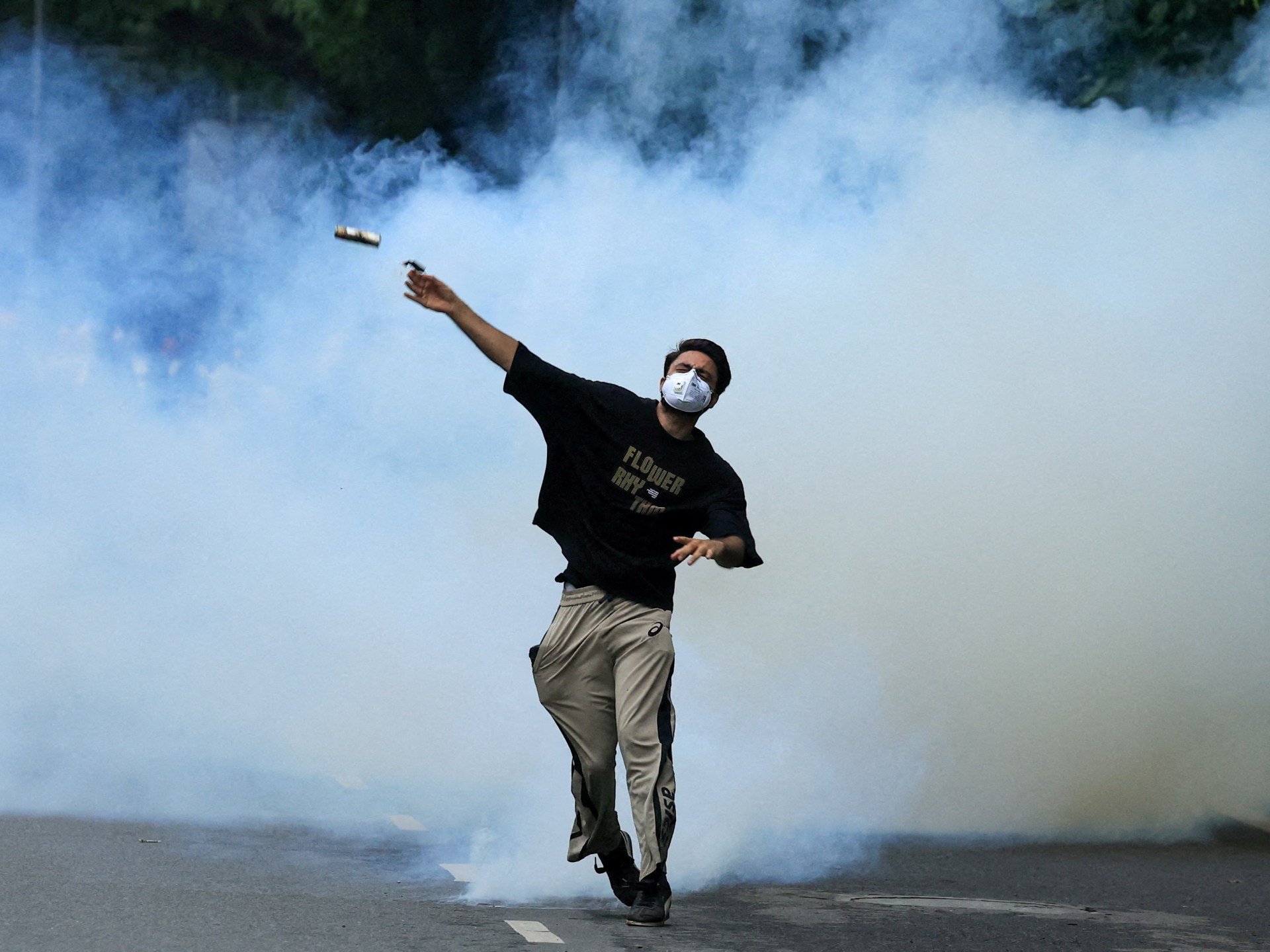
The word Azadi, meaning freedom in English, comes from a hip-hop hit in the 2019 Bollywood film Gully Boy. During this year’s demonstrations, it became the anthem of student protests in one of the biggest challenges to Prime Minister Narendra Modi’s Hindu nationalist government in years. Newly circulated videos of police beating students on Parliament Street gave a track that is nearly a decade old renewed relevance. The chants spread beyond Delhi to Jaipur, Lucknow and Mumbai.
Just ten years earlier, Azadi was among the most radioactive and criminalised slogans in Delhi, one that sent student leaders to jail on treason charges. This summer, after thousands of protesters returned home following the minister’s resignation, the lights at Jantar Mantar went dark. Rows of bright yellow metal police barricades still lined the street, many painted over by protesters. One message in red read: “Umar, Sharjeel, Gulfisha were here before you.”
The journey of the Azadi chant, from Pakistan’s feminist movement and the Kashmiri resistance to India’s mainstream, charts the evolution of both a political slogan and student activism under Modi’s decade in power. On December 9, 2016, a group of students at Jawaharlal Nehru University (JNU), one of India’s premier public universities and a hub of political activism for decades, gathered to discuss capital punishment in India, including the case of a Kashmiri man hanged for an armed attack on parliament in 2001. Banojyotsna Lahiri, a close friend of Umar Khalid and one of the event organisers, remembered the evening as banal.
Indian TV channels seen as friendly to Modi’s government turned the event into a national flashpoint, repeatedly airing footage of students chanting Azadi slogans led by then JNU student union president Kanhaiya Kumar. Pro-Modi media labelled the students “sympathisers of terrorists” and some channels aired doctored clips. The controversy “blew out of proportion,” Lahiri said. “Intense media trial picked up. It was a targeted campaign: propagating that antinational students lived off taxpayers’ money.” Within days, sedition charges and arrests followed; Khalid and others were released on bail a few weeks later.
The campaign had lasting effects. “The tag of antinational was accepted in wider Indian imagination, outside universities and these students [like Khalid] could never shed it,” Lahiri said. The crackdown that began in early 2016 also followed the suicide of Dalit student Rohith Vemula in Hyderabad, who alleged caste discrimination. Protests erupted at the Central University there and the government responded with force. Student activists faced attacks from right wing groups; Khalid was shot at in New Delhi. Universities blocked permissions for discussions, film screenings and protests. “It requires a lot of courage to be a student activist or leader in India, after coming from small towns,” said Apoorvanand, a professor of Hindi at Delhi University. “It is the first time in independent India where the government has undertaken a coordinated, well-thought-out attack on student activism.”
In 2019, protests against the proposed Citizenship Amendment Act (CAA), seen as discriminatory against Muslims, brought several Muslim student leaders in Delhi to national prominence. The government appeared to step back from a nationwide screening of citizenship, but another crackdown followed. Dozens of prominent activists were jailed and faced charges including terrorism. Six years later, leaders like Khalid, who was rearrested, and Sharjeel Imam remain imprisoned without trial.
The chant’s musical afterlife began after the 2016 JNU controversy. Music producer Dub Sharma layered electronic beats over crowd chants, using the slogans as the central melody. Those original slogans called for freedom from caste hierarchy, capitalism, hunger and the influence of the right wing Rashtriya Swayamsevak Sangh (RSS), the ideological fountainhead of Modi’s Bharatiya Janata Party (BJP). Three years later, director Zoya Akhtar tapped the track for Gully Boy, a film partly inspired by poverty of Mumbai’s slum rappers. Sharma recreated the song and recruited popular Mumbai artist Divine to rap. The revised version kept only the line “freedom from hunger” from the original crowd chants, omitting other calls for social justice. The film team faced criticism for hollowing out the track but defended the change as suited to the film’s narrative.
Divine’s version rapped about income inequality, politicians’ privileged children and a call to take over a corrupt system, themes that have since animated Gen Z protests worldwide. As India continued to slide in democratic indices, Sharma’s rehashed score became the anthem of this year’s student resistance demanding wider educational reforms.
The Azadi chant itself has older roots. Pakistan’s feminist resistance to General Zia-ul-Haq’s military dictatorship in the 1980s used it, and late Indian feminist activist Kamla Bhasin was inspired by its fluidity, adapting it to Indian contexts. Kashmiri resistance to Indian occupation adopted the slogan in the late 1980s, and the left liberal movement in New Delhi followed, each with calls specific to their struggles. A year before her death in 2021, Bhasin called the chant “a living, breathing slogan” and said, “This slogan grows every day, it evolves every day. Its meaning is not set in stone.”
The Cockroach Janta Party emerged after India’s chief justice controversially equated unemployed youth with cockroaches and parasites last June. Boston University graduate Abhijeet Dipke posted on X: “What if all cockroaches come together?” The campaign went viral, gaining more than 22 million Instagram followers, more than double the BJP’s official account. Dipke returned to India, pledging an agitation for education reforms beginning with the education minister’s resignation after a series of exam scandals affecting millions. On June 6, he landed in New Delhi and went straight to Jantar Mantar, where he stood with Neha Bora, national president of the All India Students Association (AISA), the student wing of the Communist Party of India (Marxist-Leninist). Bora, who is 29 years old and had been with AISA for eight years since her college days at JNU, said the Cockroach movement “did not have any idea about what might happen, or what to expect here”. She added, “They didn’t know what to do. They were excited but also scared.”
Student unions like AISA and the Student Federation of India (SFI), another prominent left wing organisation, helped the protest stand. They organised a camp, and six students joined Sonam Wangchuk, an educator turned activist aged 59, on a hunger strike. For a month, student volunteers took shifts to keep the site occupied, giving the protest slogans, placards and a voice that brought international prominence. Bora described the challenge: “Sit-in means a lot of repetition for those people who you’re appealing to join. As a student organisation, we knew the science behind keeping protest alive: bring in different sections of society to support the movement, like lawyers, professors and farmers.”
Opponents used a familiar playbook to delegitimise the students. Bora said they fought back against “baseless conspiracies and allegations of being antinationals or foreign-funded.” Education Minister Pradhan called the protesters the “B-team of terrorists.” This time, criminalising the young protesters failed and the demonstration grew. The movement focused on education gave student organisations a chance at national politics, said Apoorvanand.
A key difference from previous protests was religious identity. Lahiri said, “The earlier citizenship protests were for Muslims, led by Muslims. Their names were Muslims, therefore [they were] easier to criminalise.” By contrast, none of the most prominent names in this year’s protests was Muslim, though organisers repeatedly called out hate and divisive politics. Mohammad Junaid, a volunteer at the site, became the most visible Muslim face at Jantar Mantar. Before everyone had returned home, Junaid and his family members were picked up and harassed by police, he said. At one point, Cockroach leaders asked protesters to refrain from chanting “negative” Azadi slogans, but the crowd ignored the request.
N Sai Balaji, a student activist who served as AISA’s national president from 2019 to 2023, said the new generation is different. “They are tech-savvy, know how to integrate their message, and they know the language of the internet so well because they grew up there,” he said. “That is why the traditional media was useless for them. Rather, they became the media themselves. They owned their story. Something we could not do.” Social media influencers and alternative media reported the protest, and many began boycotting traditional outlets friendly to the government. “And no one was calling them antinationals in this new space,” Balaji added. When videos of Bora on hunger strike were watched by millions, he said, “India’s aspirational class, who felt betrayed by the government’s broken promises, found hope in people who were sitting selflessly. That’s where the whole propaganda vanishes. Suddenly, the people branded antinationals become humans too.”
Lahiri said the current generation broke through traditional moulds. “With their language, imagery, and Instagram reels, people outside universities are now able to connect more.” She noted that with campus spaces criminalised, students’ politics are spilling onto the streets under even harsher circumstances. “Call it shallow,” she said, laughing, “but just saying, ‘Fu** Modi,’ is more of a slap in the face, instead of our sentiments coated in academic language.” Among the flood of memes and posters, one stayed with her: “Umar Khalid walked, so Gen Z could run.” She is not sure if Khalid would agree, but she does.
Bora said the 2019 citizenship movement led by Muslims “inspired a revolution inside” her and still keeps her going. She said the Modi government criminalised the mere expression of the word Azadi by “creating so much noise around it.” However, she added, “when students faced police brutality, when the wounds of those batons were fresh on their bodies, one understands that the Azadi slogan is the most radical assertion of fundamental rights in India.”