Amazon has built a fleet of more than one million robots, yet it remains one of the world’s largest employers of people. The company says machines have taken over the hardest and most dangerous jobs in its fulfillment centers. Labor advocates and independent researchers say the full story is more complicated, with automation reshaping the pace of work and the risks that human employees face.
A Million Robots and 1.5 Million People
Amazon has deployed more than 1 million robots, but it is also the second largest corporate employer in the world, with more than 1.5 million people working full time or part time, according to its 2025 annual report. Company executives say the expanding robot fleet has made life easier for human workers by absorbing the toughest tasks in fulfillment centers, the jobs most likely to cause physical fatigue and injury. Labor advocacy groups and independent researchers argue that the picture is not so simple, pointing to evidence that warehouse automation powered by AI carries risks as well as benefits for the people who work alongside machines.
Brian Greenwood, a professor of business at George Mason University, told Ars that automation has traditionally happened away from workers. In the past, he said, dangerous tasks were removed from people and handled at a distance. Collaborative robots change that, Greenwood explained, because they work close to people and can set the pace of work. “The rise of collaborative robots really changes that dynamic for two reasons: one is that it is physically proximate, and two, the robot has the ability to dictate the pace of work,” he said.
Much warehouse work also falls into the category of dull, dirty and dangerous tasks that people may be happy to hand to machines. According to the US Occupational Safety and Health Administration, the injury and illness rate in the US warehouse sector has typically been more than double the average across all industries. Greenwood noted that almost 2 million people work in warehousing in the United States, a sector marked by very high turnover and very high workplace injury rates.
Even so, robots remain far from able to perform the many different tasks that humans can handle. Amazon therefore still relies on a vast human workforce that works alongside its growing fleet of wheeled robots and robotic arms. The arrangement can become complicated when people are expected to keep pace with robotic counterparts.
From Kiva to DeepFleet
Amazon’s robot fleet grew quickly after the company acquired the robotics firm Kiva Systems in 2012. Kiva was among the first to develop wheeled mobile robots that carry racks of items to warehouse workers, rather than making people walk through fulfillment centers to collect goods from shelves. After the acquisition, Kiva was renamed Amazon Robotics. The unit has focused on deploying mobile robots and robotic arms, most of which Amazon manufactures internally at facilities in Massachusetts. This year Amazon announced it would build additional production factories in Austin, Texas, and Greenwood, Indiana, to produce more robots.
Scott Dresser, vice president of Amazon Robotics, told Ars that the company looks at the challenges it can help its associates and employees with, and how technology can improve customers’ lives. He said Amazon tackles hard or deep technical challenges step by step to reach that goal.
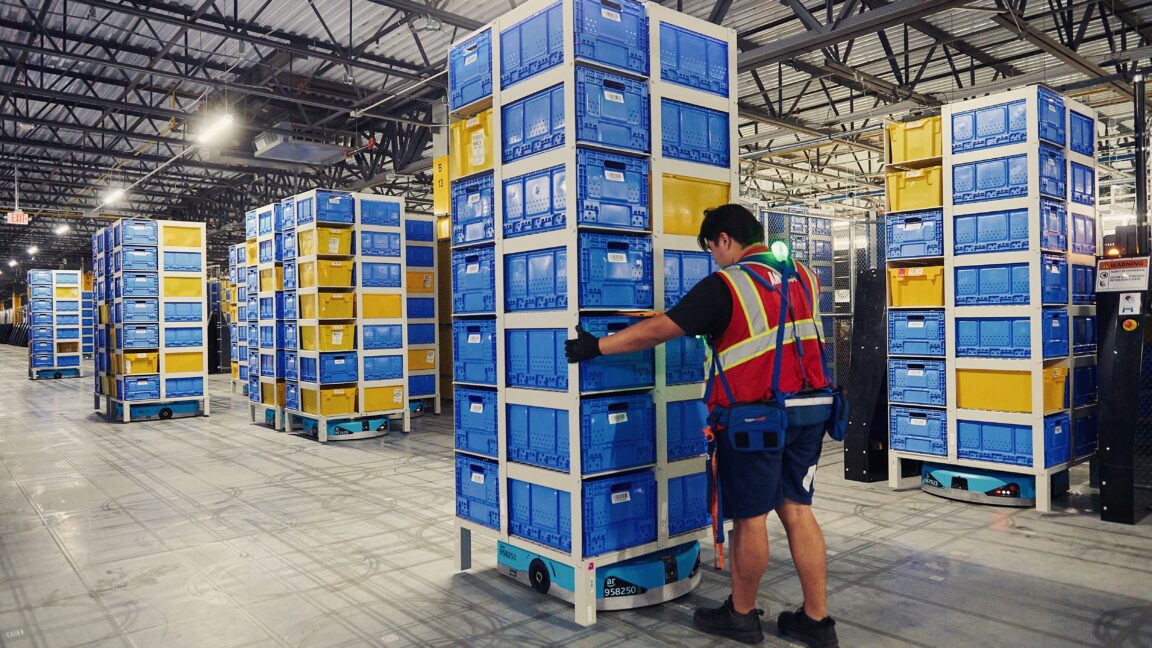
Most of Amazon’s million robot fleet still consists of wheeled mobile robots. Amazon says its Sequoia system can identify and store items up to 75 percent faster at fulfillment centers by coordinating swarms of those robots. Hercules and Titan robots, which are about the size of a pool table and a baby grand piano respectively, move through warehouse aisles to retrieve tall shelving units covered in fabric. Those units, called pods, are packed with plastic tote crates and delivered to human employees at workstations.
Such mobile robots generally follow grid lines of stickers placed on the floor and remain inside fenced areas away from human employees. The newest mobile robot, Proteus, has sensors that let it operate safely around people and other objects in a more freely roaming role. Swarms of mobile robots moving through narrow lanes between storage pods can sometimes create robotic traffic jams. Amazon began coordinating its robots with a suite of AI foundation models collectively called DeepFleet, which can predict possible robot congestion before it happens.
More recently, Amazon has been deploying a growing number of robotic arms. These machines can grab items stored high inside inventory pods, sort packages and place them in carts or on mobile robots, and handle many of the individual products that customers order online.
Robotic Arms Learn to Pick
Amazon expects to more than double its existing fleet of robotic arms this year, according to Amazon CFO Brian Olsavsky during a July earnings call. When Ars asked for clarification, Dresser described the current number of deployed robotic arms as being in the single digit thousands.
Amazon first bought robotic arms from outside suppliers to help lift and stack heavy pallets and bins inside fulfillment centers. The first robotic arm developed internally by Amazon Robotics to sort individual mailer envelopes and boxes from cluttered piles, called Robin, began testing in 2021 and debuted at a facility in Lakeland, Florida, in 2022.
Dresser said Robin was the company’s first attempt at taking a jumble of customer orders and building advanced robotics to identify items in that scene, decide how to pick them up, and create a motion plan that would successfully place each item on a mobile drive unit.
The robotic arm uses eight suction cups to pick up individual packages. Before it acts, the robot’s software analyzes a view from above of the conveyor belt cluttered with packages and quickly ranks possible picking actions.
In a 2023 research paper, the Amazon Robotics team described developing several picking strategies for the robots early on, each with its own limitations. One strategy that prioritized larger packages struggled when smaller packages lay on top of or overlapped with larger ones. Another strategy that favored packages near the top of piles failed in practice to retrieve what the team called unreachable picks and partially buried packages.
Improvements came from replacing manually designed algorithms with an AI approach known as machine learning. The machine learning model initially trained on more than 394,000 picking actions from deployed robotic arms to estimate the probability that a pick would succeed. It then used an online pick ranker to prioritize the best actions for the Robin robots.
The best machine learning method in that trial achieved a 93.73 percent success rate, compared with 92.28 percent for the best performing traditional algorithm. That gap may look small at first, but it meant the machine learning method produced about 16,500 fewer failed picks than the traditional method during a work period involving more than 1 million total picks. That difference matters for an operation such as Amazon’s, which prizes speed and efficiency at scale.
The Amazon Robotics team further showed that a machine learning method could reduce the failed pick rate by 20 percent during an experiment involving 2 million picks by robotic workstations set up to resemble the operations of Amazon’s Robin fleet. They presented the work at the International Symposium on Experimental Robotics in July 2025.
Cardinal, Sparrow and Vulcan
Next came Cardinal, a robotic arm that can place packages weighing up to 50 pounds into wheeled carts that are eventually brought to Amazon trucks waiting at loading docks. These robots first began operating at a facility in Nashville, Tennessee, in November 2022.
Dresser compared the task to a game of Tetris: sorting packages and placing them into a cart while trying to pack the cart as densely as possible. He said dense containers are good from a sustainability perspective and from a transportation cost perspective.
Cardinal built on lessons from Robin’s development in picking up and manipulating packages, while adding the ability to pack customer orders densely into carts. Amazon has just started to deploy Cardinal in larger numbers and will continue to do so over the next several years, Dresser said.
Robin and Cardinal can handle several dozen package variations. The newer Sparrow robotic arm was developed for a harder task: handling hundreds of millions of products of varying shapes and sizes that can go into customer orders. Sparrow focuses on consolidating items from partially filled container size totes to create densely packed totes. As items are picked to fulfill customer orders, Sparrow continually refills the totes.
Dresser told Ars that Sparrow was the first place where Amazon truly deployed foundation models that enabled it to deal with a high diversity of products. Such models helped the Amazon Robotics team efficiently identify and classify hundreds of millions of items so it could develop new robotic strategies for grasping them. They also removed the need to manually code every single item.
More recently, the Amazon Robotics team created a foundation model for robotic perception that can handle new products that have never been seen before in Amazon fulfillment centers. The team also developed a generalized action model compatible with different types of robotic arms that may use varying combinations of suction and finger grasping.
Kapil Katyal, a senior applied science manager at Amazon Robotics, said during a presentation attended by Ars at the Intelligent Robots & Systems conference in Pittsburgh on September 29 that building ad hoc perception models for every task and embodiment simply does not scale. He said one initiative his team took up was to design a foundation model that could work for any new embodiment of robots Amazon deploys and across all the perception tasks the company needs to perform.
Most of the robotic arms have relied primarily on vision. Amazon’s newest robotic arm, Vulcan, is the first to combine vision with force feedback sensors that provide a sense of touch. That allows the robot to accurately pick out or stow away items within the fabric covered inventory pods.
Dresser said the robot needs to insert an item, create space or pull something out. Those are hard tasks for traditional systems that do not rely on touch, he said, such as the suction based systems used by Sparrow.
Vulcan began operating at Amazon fulfillment centers in Spokane, Washington, and Hamburg, Germany, starting in 2025. It is not widely deployed yet, but Dresser said Amazon expects to scale up use of the robotic arm in 2027.
Amazon says each new robot has benefited its human workforce. Vulcan, for example, focuses on picking and stowing items in the top rows of inventory pods, work that would otherwise require a person to use a ladder. It also handles items just above the floor. That lets employees concentrate on picking and stowing items within more comfortable reach.
The Safety Debate
Investigations by labor advocacy groups, journalists and the US Congress have painted a less rosy picture of Amazon’s automation drive over the years. The Strategic Organizing Center, a coalition of trade unions headquartered in Washington, DC, published reports in May 2021 and April 2022 showing higher injury rates at Amazon’s robotic warehouses compared with warehouses that do not use robots. The analysis drew on injury data that companies reported to the US government from 2017 through 2020.
Joan Moriarty, director of strategic research and campaigns at the Strategic Organizing Center, said in an email to Ars that Amazon likes to talk about its latest robots because it does not want to talk about the tens of thousands of Amazon workers who are injured every year due to what she described as Amazon’s obsession with maximizing speed and minimizing costs.
The organization also gathered nearly 1,000 responses from Amazon workers in an online survey conducted in February 2021. Moriarty said workers consistently report that the presence of robots increases the pace of work expected in Amazon facilities, forcing them to make fast, repetitive motions and substantially increasing the risk of injury.
The US Senate Committee on Health, Education, Labor and Pensions also conducted a 2024 investigation led by Senator Bernie Sanders, an independent from Vermont. The committee’s report noted that Amazon’s internal data also suggested a link between robotic productivity and increased pressure on human workers, leading to higher injury rates.
Amazon has described those reports as flawed and reliant on older data that predates the deployment of its most modern robots, including the robotic arms that became operational over the past several years. The company also pointed to improvements in its overall workplace injury rates without detailing possible differences between robotic warehouses and facilities without automation.
An Amazon spokesperson told Ars that the claims ignore the fact that since 2019 the company’s Global Recordable Incident Rate has improved 43 percent and its Global Lost Time Incident rate, which includes the most serious injuries that require employees to take time away from work, has improved 70 percent. The spokesperson said Amazon’s consistent year-over-year improvements have worked in parallel with its robotics growth across its operations network.
The most nuanced findings may come from a research study published in the journal ILR Review in April 2025. That analysis showed that Amazon’s robotic warehouses had a 40 percent decrease in severe injuries compared with legacy fulfillment centers, suggesting some benefits from having robots take on the most physically challenging and risky tasks. However, the same study found that robotic fulfillment centers had a 77 percent increase in less severe injuries associated with physical strain from repetitive motions.
Greenwood, one of the paper’s coauthors, said at least one mechanism by which this appears to be manifesting is the pace of work. He said pick rates for robotic fulfillment centers are off the charts higher. A faster pace driven by partial automation could mean the robot is dictating the pace of work and pushing human employees to perform certain repetitive actions more quickly, Greenwood told Ars. He said that appears to be what is driving the strains and sprains the researchers observed.
The study drew in part on Amazon company data obtained by journalists at Reveal and The Center for Investigative Reporting, covering weekly data at more than 150 Amazon warehouses from 2016 through 2019. Although the data is older, Greenwood said the findings remain relevant to Amazon’s ongoing automation efforts. He said he has not seen a tremendous amount of evidence suggesting these dynamics are changing, noting that turnover remains very high in warehousing, and not just at Amazon.
Greenwood and his colleagues also analyzed online comments posted on Reddit by Amazon fulfillment center employees. In those comments, employees described work at robotic fulfillment centers as less physically stressful but mentally exhausting because of the physical repetitiveness and faster pace associated with higher productivity expectations.
Jobs, Unions and the Road Ahead
A central question is whether automation by Amazon and other companies will end up replacing some potential human hires with robots. Amazon has promoted its robotics push as a source of new job opportunities for human employees. Fulfillment centers with advanced robotics typically require 30 percent more employees working in reliability, maintenance and engineering roles, according to the company, and the new factories for manufacturing additional robots are each expected to bring more than 300 jobs.
Dresser said that as Amazon recognizes each robotics development can change the nature of work, it is providing opportunities for employees to upskill and learn new skills. He said the company has increased the number of robotic maintenance technicians in its network by over 30 percent, and that this is a much higher skilled and better compensated job.
Amazon has also described its automation efforts as going hand in hand with a growing business that needs more human employees. A spokesperson told Ars that as Amazon has deployed robots over the past decade, its operational footprint has grown, creating hundreds of thousands of jobs as the network expanded.
However, there have apparently been internal discussions at Amazon about robots potentially reducing the need to hire humans. In October 2025, The New York Times reported on internal strategy documents suggesting that the robotics push could allow the company to reduce projected hiring needs in the United States by more than 160,000 people by 2027 and 600,000 people by 2033. An Amazon spokesperson responded at the time by saying the documents reflected the views of just one group inside the company.
Even as Amazon looks to build its robotic fleet beyond the million robot mark, discussions about workplace safety and working conditions are unlikely to disappear. Only a very small fraction of Amazon’s hundreds of thousands of employees have unionized in the United States. Greenwood said labor unions have traditionally served a valuable role in improving worker safety.
Greenwood said he understands that firms are not always eager to engage in that conversation, and he could not say that unionization would solve the problem at Amazon. But he said developing a better relationship between management and labor is usually the best path toward reducing injury rates, which would benefit Amazon as well.
The first Amazon Labor Union, organized among workers at a warehouse in Staten Island, New York, in April 2022, has been pushing what it describes as a Safety Bill of Rights. The document outlines changes the union wants to make its workplace safer. The image accompanying the document declares: “We are not robots.”
Amazon’s robot fleet is still growing, and so is the debate over what it means for the people who work beside it. The company points to safer, less physically demanding jobs and new skilled roles. Labor groups and researchers say the pace of automated work remains a central concern. How those two realities are reconciled will shape working conditions in Amazon’s warehouses for years to come.