
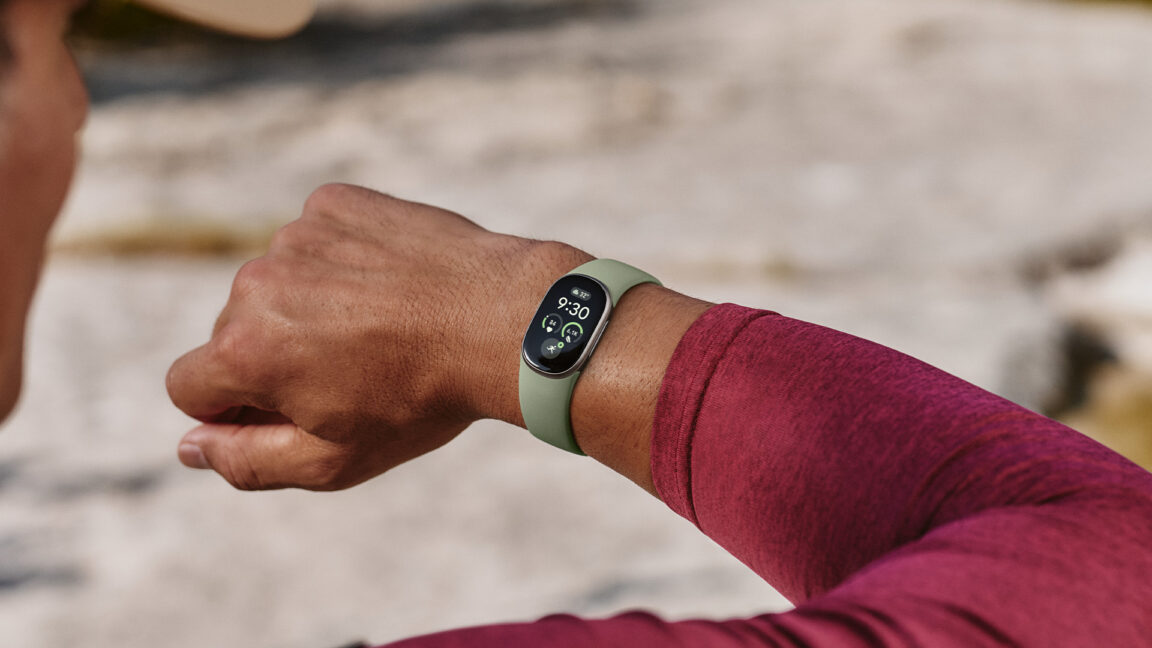
Google has announced the Fitbit Edge, a new fitness tracker that sits between the Pixel Watch 5 and the Fitbit Air. It is essentially a new Charge 6, but its design borrows more from Google’s smartwatch. Squeeze the Pixel Watch from the sides, and the result is the Edge.
A Middle Ground in Google’s Wearable Lineup
The Edge has a pill shaped 1.34 inch OLED touch display inside a slender aluminum frame. It is rated IP68 (5 ATM) for water and dust protection. Google says the screen offers 46 percent more viewable area than the Charge 6. The tracker is very close in overall size to the Fitbit Air and uses the same magnetic charging puck.
The device works with Android or iPhones through the Google Health app. It can run for about seven days on a charge. When it is away from a phone, it can still follow activity all week, with support for seven days of full health data storage or 30 days of basic data. That weeklong battery estimate does not include always on display mode. With that mode turned on, battery life drops to about two days, barely longer than the Pixel Watch 5.
Within Google’s wearable lineup, the Edge takes a middle position not only in price and size but also in button count. The Pixel Watch has two buttons, the Air has none, and the Edge has one tactile side button. That button can wake the device or start and pause workouts. Most other interactions are handled through the touchscreen.
The Edge will ship with a collection of fitness focused experiences and watch faces, and users will not be able to download more. Its software looks a lot like the Pixel Watch’s, but it is not a full version of WearOS. The tracker can mirror notifications from a phone, but it has no microphone or speaker. Responses are limited to predefined quick replies, and there is no support for Gemini interactions. The Edge also lacks NFC, so Google Wallet tap to pay is not available.
One notable upgrade over the Fitbit Air is GPS built into the tracker. That allows users to track an outdoor activity without bringing a phone along. Google says the GPS is not as accurate as the dual band GPS radio in the Pixel Watch. The Edge does keep the ECG and blood oxygen sensor from the Pixel Watch, which are not available on the Air. It also includes an altimeter, an optical heart rate sensor, and a skin temperature sensor.
All that data travels over Bluetooth 5.4 to the Google Health app, previously known as Fitbit. The app feeds the information into the Health Coach chatbot, which is powered by Gemini. The device includes three months of Google Health Premium, without which the AI features are unavailable. Some users may prefer to skip the AI. The Premium subscription costs $10 per month. It is included with Google AI Pro, but the Health Coach can be disabled.
Like the Pixel Watch, the Edge comes with the basic silicone Active Band for $180. A Stephen Curry Special Edition is available for $220. The Edge has a custom band connector similar to the Pixel Watch, but the plug is a different size. Options from other companies will eventually arrive, but Google plans to have a line of additional bands at launch. Those include the Active Sport, a silicone band with holes, for $40; the Performance Loop, made of polyester fabric, for $50; the Magnet Band, which is leather like but still silicone, for $60; and a Metal Links Band for $150.
The Fitbit Edge is available for preorder today and will ship on October 27. It comes in matte black, polished silver, satin pyrite, which sits between silver and gold, and champagne gold. The Edge is much more expensive than the $100 Fitbit Air, but it costs only a little more than the Charge 6’s 2023 launch price of $160. The Pixel Watch 5 starts at $350.
Like the Air, the Edge is not an island inside Google’s ecosystem. Users can pair multiple Google wearables with the Health app and wear whichever one they want. There is no need to pair again or manually switch health tracking. The app collects stats from the device worn at any given time, changing as often as necessary. Someone could wear the Pixel Watch 5 during the day and the Edge at the gym, for example.
Google also says the Edge is built to stay with users for the long haul. It is the company’s first repairable fitness tracker, and it was designed with a replaceable battery. That does not mean users can replace the battery themselves. Service options will be available to swap the battery, but Google still does not recommend opening the tracker yourself.
The Fitbit Edge will sit between the Pixel Watch 5 and the Fitbit Air in Google’s lineup. It offers more screen area than the Charge 6, GPS built into the tracker, and a replaceable battery, but it also makes clear tradeoffs in software, sensors, and price.