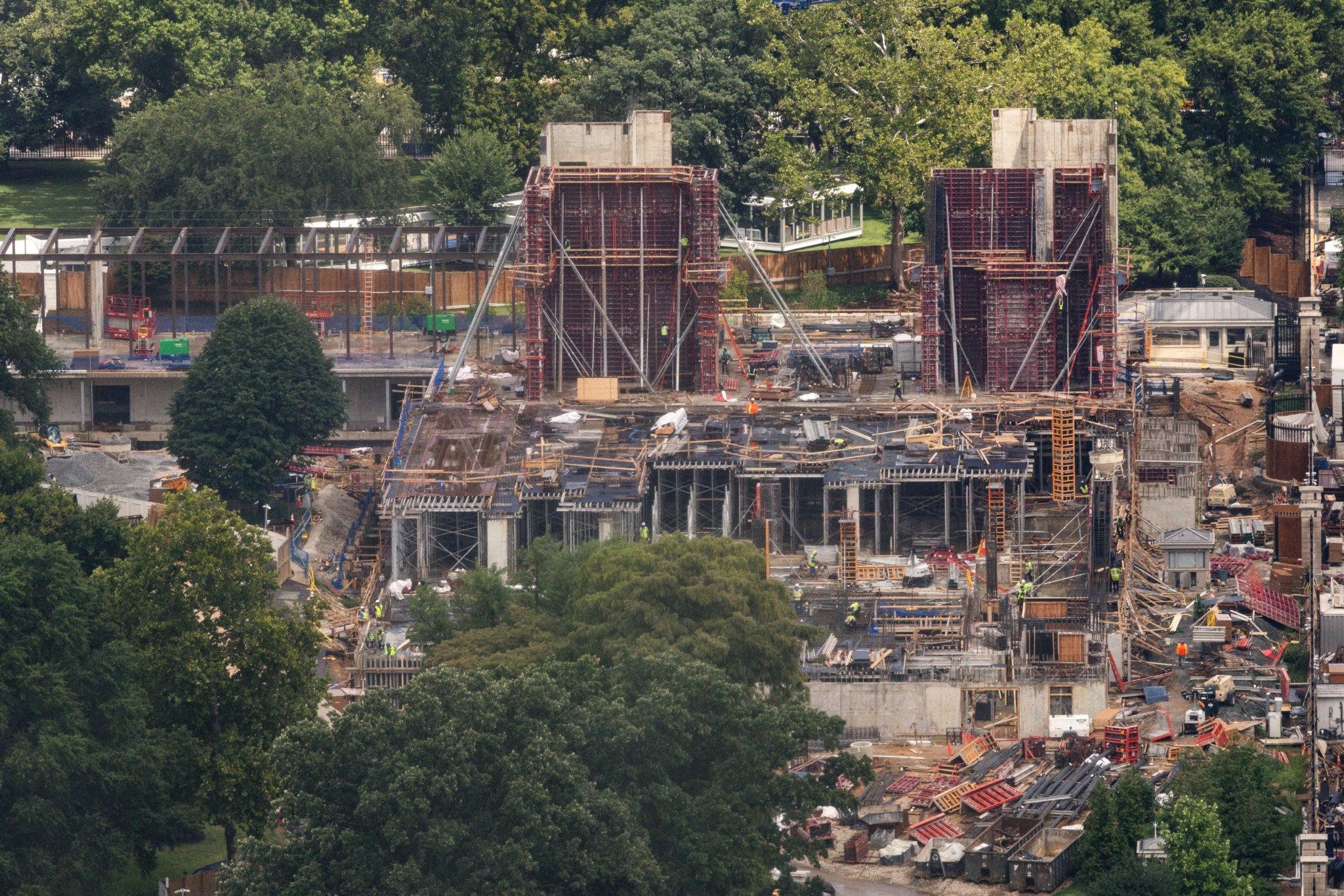
The Trump administration took its fight over the $400 million White House ballroom project to the Supreme Court on Friday, asking the justices to allow construction to move forward while it challenges a lower court’s order to halt the work.
Solicitor General D. John Sauer filed an emergency petition requesting that the high court suspend a ruling by a three judge panel of the U.S. Court of Appeals for the District of Columbia Circuit. That panel, in a 2 to 1 decision last week, said Congress had not approved the project and ordered a stop to the ballroom’s construction.
Chief Justice John Roberts set a Tuesday deadline for plaintiffs challenging the project to respond. The appeals court had temporarily stayed its own ruling for two weeks, giving the administration time to appeal. The construction halt is set to take effect on Aug. 21 unless the Supreme Court intervenes.
In the filing, Sauer described the lower court’s injunction as extraordinary and unlawful, arguing that it would disrupt an ongoing military construction effort at the East Wing. He wrote that the integrated military complex, including a totally secure ballroom space, is vitally required by national security.
The filing also contained the Trump administration’s first confirmation that a threatened missile attack on Air Force One on July 8 led the Secret Service to secretly fly President Trump out of Turkey last month on an alternate military aircraft. That threat was cited among recent assassination attempts against Trump as part of the case for a secure ballroom space.
The administration maintains that the project is on time and under budget, relying on roughly $400 million in private donations and no taxpayer dollars. However, Democrats in Congress have said it appears that money from Trump’s tax cuts bill is funding the work. The administration also has requested additional appropriations from Congress, which have not been approved.
The legal battle began in April, when U.S. District Judge Richard Leon, a George W. Bush appointee, ordered a stop to aboveground construction but allowed underground work to continue, including bunkers, military installations, and medical facilities. The D.C. Circuit panel upheld that pause, siding with historic preservationists who sued to block the ballroom.
The majority opinion, written by two judges appointed by Democratic presidents, said the decision whether to build a massive ballroom belongs to Congress, not the executive. The judges wrote that the matter is not a case for executive self help. Judge Neomi Rao, a Trump appointee, dissented, arguing that the preservationist group lacked standing and that the district court had elevated aesthetic displeasure over security interests.
The Trump administration argues the president has unimpeded authority to renovate the White House and that leaving the site as an open construction pit makes the building harder to protect. The Justice Department also contends that the National Trust for Historic Preservation, the plaintiff, does not have legal standing to sue. Sauer wrote that the ballroom project should be a matter for the President and the political process, not construction by injunction.
The trust responded by accusing the White House of trying to outrun the courts, pointing to plans to install 1 million pounds of rebar and pour 3,000 cubic yards of concrete in the next week alone. The plaintiffs said in a statement that the administration’s transparent efforts to evade the rule of law, frustrate judicial review, and limit the availability of meaningful relief must stop.
During an appeals court hearing in early June, Justice Department lawyer Yaakov Roth argued for broad presidential control over iconic public facilities. When asked a hypothetical question, Roth said the government could bulldoze the Statue of Liberty and the White House, and descendants of immigrants who came through Ellis Island and the enslaved people who built the White House would not have standing to sue.
The ballroom has been under construction for 10 months, and the administration says it is about 65 percent complete. Sauer wrote that the injunction would create chaos in service of nothing.
The Supreme Court now must decide whether to let the construction continue while the broader legal dispute over presidential authority and congressional approval plays out. The response from the plaintiffs is due by Tuesday, setting up a potential decision before the appeals court’s stay expires on Aug. 21.