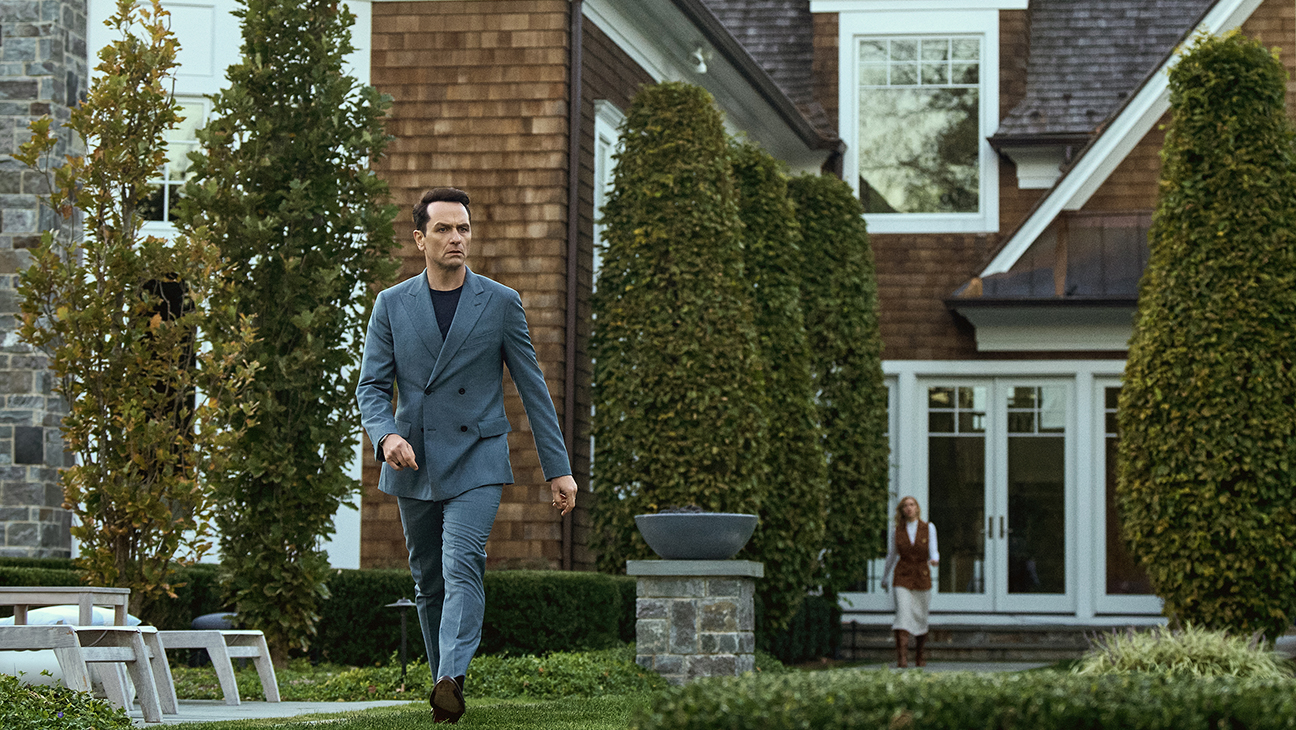
The showrunner behind Netflix’s ‘The Beast in Me’ knows that a particularly brutal murder scene in the limited series is dividing viewers. In an interview, Howard Gordon explains that choice, the long road to getting the show made, and why Matthew Rhys was the right actor for the lead role.
Howard Gordon, the showrunner behind Netflix’s limited series “The Beast in Me,” acknowledges that a particularly brutal murder scene divided viewers. “There were people for whom that was a potential tune-out point. Maybe some others tuned in extra because of it. It’s hard to tell,” Gordon tells The Hollywood Reporter.
In the show, the scene in question is a flashback showing the violent death of Madison Jarvis, played by Leila George. She is the wife of Nile Jarvis, played by Matthew Rhys, and her killing answers the central question Aggie, played by Claire Danes, has been trying to solve while writing a book about her neighbor: Did he or didn’t he kill his wife? Aggie is also grappling with the death of her own son.
A difficult premise to get moving
Gordon, who also produced “24” and “Homeland,” said the premise took years to develop. Gabe Rotter wrote it six or seven years ago, and Gordon explained why it was challenging. The pilot introduces a writer who is stuck in an existential kind of “stuckness” because of a terrible loss. But the idea of writing a book about someone is “pretty static,” Gordon said, so they had to find the drama in the cat and mouse dynamic.
In earlier versions, Nile was exiled to the suburbs and spent his time painting. That left two solitary characters with few people around them, which Gordon called a challenging premise. They gave Nile the real estate development Jarvis Yards, expanded Aggie’s relationships, and explored Nile’s father. The core of the show became “that universal fact of loss and how it can bend us,” but too many traumas were obscuring the story. “So most of it was about clearing the brush and finding the story,” he said.
Keeping the mystery in the gray zone
The series constantly keeps the audience wondering whether Nile killed his wife. Gordon said the goal was to keep that possibility open while also thinking about what would happen if he wasn’t the killer. “We planted certain flags at various points,” he said. He also noted the challenge of handling backstory about Aggie’s loss and Nile’s previous marriage without turning the show into “reading headlines for an entire eight episodes.” The backstory had to be brought into the present and kept alive.
Gordon also addressed a specific storytelling problem with the pilot. At the end of the first episode, Aggie whispers her darkest secret to Nile, that she wishes her son’s killer were dead. Then that secret gets enacted. Gordon said this makes little sense unless you look at it through the prism of a sociopath. “You’re not going to find very many answers there” if you look for rational cause and effect within a healthy human being with a conscience. “You have to embrace the sociopathy.”
Casting Matthew Rhys
Gordon said he had high expectations for Rhys, but the actor “blew them away.” Nile Jarvis, he said, was the hardest character to decode. The language of a sociopath could easily become cliché, but Rhys brought humanity and vulnerability. “His secret was not just to make him charming, but to make him, by turns, dangerous and vulnerable,” Gordon said.
The show also explores an improbable love affair, with sex taken out of the equation. “These are two people who are uncomfortably alike who find each other and actually connect in a way,” Gordon said. That connection leads to betrayal once Aggie’s true purpose is revealed.
The violence and the decision to go all in
On the graphic murder scene, Gordon said he tended to be “the grandpa” on the production. Executive producer Antonio Campos was “the captain of the ship on the set,” but also an active producer. “There is a sort of rough democracy,” Gordon said. “Being the showrunner, I got to cast the winning vote often, but I do hear it when I’m outvoted.”
“In instances like that, where I felt it was, ‘Whoa,’ where I was a little squeamish, you have to just embrace that this is a really violent moment, and this is a very broken, evil, awful person. And you may as well go all in,” he said. “In for a dime, in for a dollar.”
“At the end of the day, you have to be the sort of lightning-rod litmus test for your audience. That really felt like it was consistent with the tone and the texture,” Gordon said, acknowledging that some viewers might have tuned out, while others might have been drawn in.