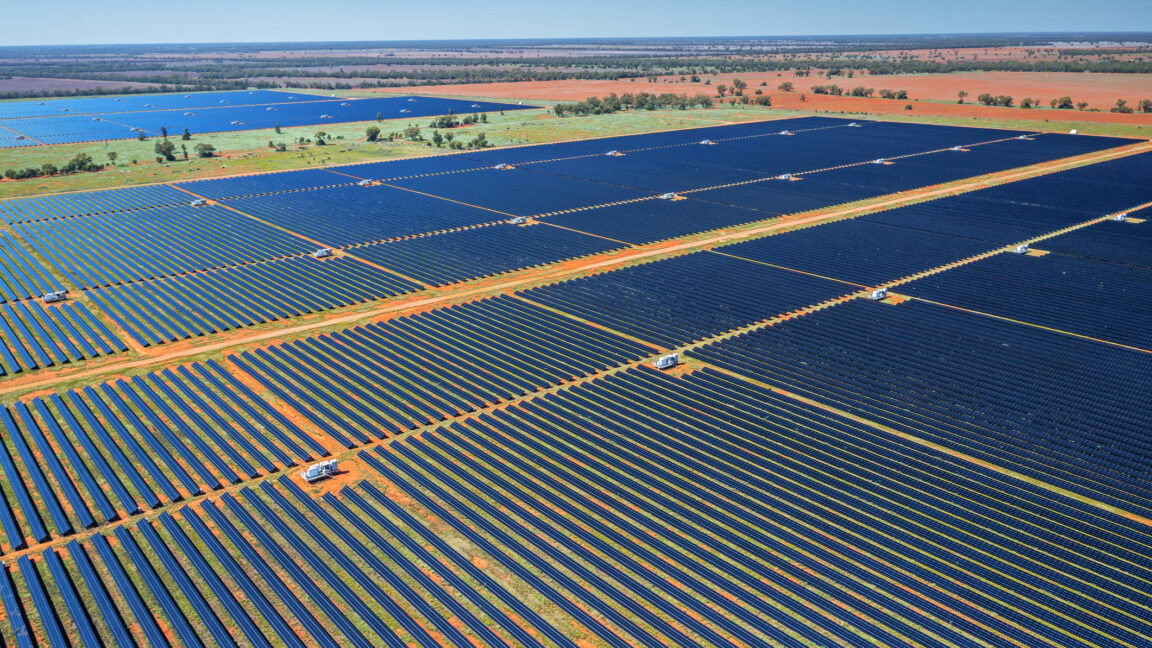
According to data from the US Energy Information Administration, 368 utility-scale power plants started operating across the country from January through June of this year. The single most striking feature of that list is how heavily it tilts toward utility-scale solar.
The group is led by two enormous wind projects in New Mexico, SunZia Wind South and SunZia Wind North. Together they have a combined generating capacity of 3,650 megawatts, making them the largest wind farms in the United States. Both came online this spring after roughly a decade of development. However, they stand out as a reminder of an earlier wind power boom rather than evidence of a current one, because onshore wind development has slowed considerably due to regulatory and public opinion challenges.
Next on the list is the Trumbull Energy Center in Ohio, a 900-megawatt combined-cycle natural gas plant. The facility is part of a broader expansion of gas-fired generation in the PJM Interconnection region, which covers portions of the Mid-Atlantic, Midwest and South.
After that comes Vineyard Wind, an offshore wind project near Massachusetts. It is the fourth-largest new plant if the two SunZia projects are counted separately. Like the SunZia projects, Vineyard Wind spent many years in development, and its completion does not signal much about future offshore wind trends.
It is not until the fifth-largest new plant that the data reveal the broader trend. Green River Energy Center in Utah includes 400 megawatts of solar and 400 megawatts of battery capacity, for a total of 800 megawatts.
Across the first half of 2026, utility-scale solar dominated in the number of projects, with 207 installations. Battery projects ranked second at 95. Natural gas combustion turbines accounted for 22 projects, while natural gas internal combustion engines added 21. Combined-cycle natural gas, despite having a very large amount of announced capacity in development, saw only three projects come online. The surge of new gas plants is still a few years away.
Measured by generating capacity, utility-scale solar again led with 11,458 megawatts. Battery storage followed with 8,207 megawatts. Onshore wind recorded 5,473 megawatts, though most of that came from the two SunZia projects. The three largest categories of natural gas plants added a combined 2,707 megawatts. Rooftop and other small-scale solar are not included in these figures.
Comparing these technologies requires care. Solar plants do not produce power at night, and many gas plants run only a small number of days or weeks each year to meet peak demand. Eric Gimon, a senior fellow at Energy Innovation, a San Francisco think tank, noted that most of the new projects are small and mid-size solar installations that rarely attract attention but are spread across many locations. Many are paired with batteries. “These kinds of smaller-size projects are just easier to build, and the site possibilities are much more diverse and easy to find,” Gimon said.
Texas, New Mexico and Arizona together accounted for about half of the country’s new generating capacity. Texas was the leader, but its mix leaned more toward batteries and gas than other states. Texas added 3,067 megawatts of battery capacity, 2,311 megawatts of utility-scale solar, and 1,154 megawatts from natural gas combustion turbines or internal combustion engines. State policies have encouraged gas and battery construction to strengthen grid reliability during high demand periods. The state also demonstrates how difficult the market has become for new onshore wind: Texas is the national leader in onshore wind capacity but brought no new wind projects online in the first half of the year.
For Gimon, the data confirm that the country is firmly in an era of utility-scale solar, with batteries playing a supporting role. “The real underlying workhorse is solar plus battery,” he said.
Looking ahead, the Energy Information Administration’s list of planned power plants suggests the utility-scale solar boom is likely to continue. The final years of this decade are also shaping up to bring a wave of natural gas plant completions. But the exact size of both booms is hard to predict because of uncertainty over electricity demand growth and how much of that growth will come from AI data centers.
For now, the most reliable picture comes from what has actually been built. Everything else remains full of questions. This article originally appeared on Inside Climate News, a nonprofit, non-partisan news organization covering climate, energy and the environment.