
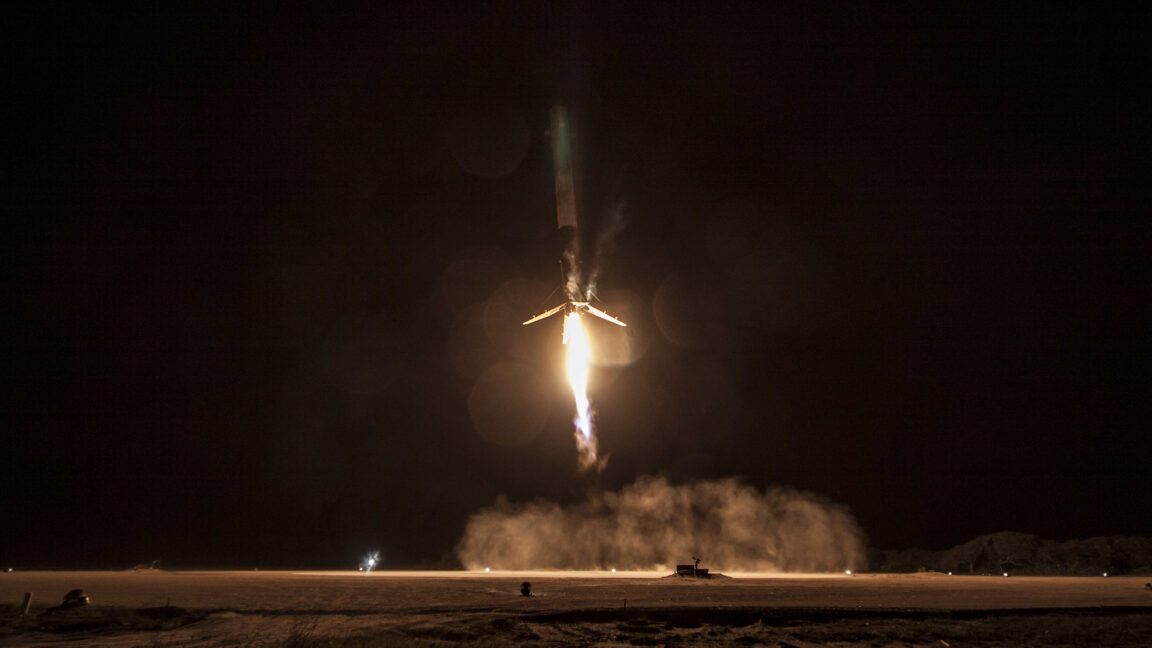
A fresh analysis of more than 6,700 orbital launches stretching back to 1960 has quantified what many in the space industry already suspected: SpaceX’s Falcon 9 and its reusable first stage have fundamentally rewritten the economics of getting to space. The research, published in Economics Letters, finds that Europe now spends three times more than the United States to launch a comparable payload, while the United States accounted for more than 82 percent of all mass sent to orbit in 2024.
SpaceX has become the carrier for more than three quarters of all mass launched into orbit, much of it the company’s own Starlink satellites. Because of its lower costs and a shortage of alternatives, the firm has also launched payloads for direct rivals such as Amazon, Northrop Grumman, AST Space Mobile and OneWeb, among others.
The new paper from public policy researchers in the United Kingdom and Italy draws on a dataset covering more than 6,700 launches from 1960 to 2025. It shows how the introduction of the Falcon 9, the adoption of booster reuse and the rocket’s high flight rate have upended the global launch market.
One of the most dramatic shifts appears in cumulative payload delivered to orbit by country. Between 1990 and the early 2000s, the United States and the Soviet Union, and later Russia, moved in close parallel. After the Space Shuttle Columbia accident in 2003, Russia pulled ahead. That trend began to reverse in the middle of the 2010s, and then the Falcon 9 ramp up in the early 2020s allowed the United States to break away sharply. In just a few years, the United States has more than doubled all of Russia’s orbital payload since 1990.
The authors also examined annual shares of global payload. They write: “Another way to look at it is to analyze the shares of yearly global payload captured by selected spacefaring nations. Between 1995 and 2012, the US share of global payload collapsed from almost 50 percent to a trough of less than 20 percent, far below Russia and only a few percentage points above China and Europe. Since then, it accelerated rapidly to a peak of over 82 percent in 2024.”
Cost comparisons show a similar divergence. Ten years ago the United States and Europe had roughly equal launch costs. Today, according to publicly available data, launching a comparable payload from Europe costs three times as much as from the United States. The researchers estimate the average cost of sending one kilogram to orbit in the United States is $3,225. Japan follows at $5,287, China at $5,809, Russia at $6,682, and Europe at $9,897. India’s figure is even higher at close to $15,000 per kilogram.
The authors acknowledge that India’s number may seem surprising. They write: “The very high figure for India might be counterintuitive as it stands in stark contrast with the narrative of the country’s frugal space program. However, this is a result of focusing on small rocket sizes, which implies that, albeit being low by international standards, fixed costs get amortized over a limited payload.”
The paper identifies larger rockets, higher launch cadence and reusable vehicles as the main factors driving down costs. For countries that choose to rely only on their domestic rockets, the researchers say expenses will rise, potentially slowing efforts to build satellite constellations and other space based operations. The policy dilemma is particularly acute in Europe. The authors state: “Looking specifically at Europe, for now the continent is stuck between a rock and a hard place, having to choose between continuing to depend on lower-cost American launch technology and relying on expensive, poorly scalable domestic technology to expand its strategic presence in space.”
To stay competitive, the authors argue, spacefaring nations will need modern launch capabilities. The United States currently leads in reusable launch, and nearly all new commercial rockets under development include some form of reuse. Chinese companies are also advancing the technology. Europe’s efforts, by contrast, have been slow. The European Space Agency’s Themis program, designed to demonstrate small suborbital hops, was originally scheduled for low altitude tests by 2022. The vehicle has still not left the ground.
The findings leave European policymakers facing a difficult choice without an easy near term solution. Continuing to buy American launches keeps costs down but extends strategic dependence, while investing in domestic rockets raises costs and may delay the continent’s ambition to expand its presence in space. As the Falcon 9 and future reusable vehicles push launch prices lower, the gap between the United States and the rest of the world remains a central challenge unless other nations accelerate their own reuse programs.


