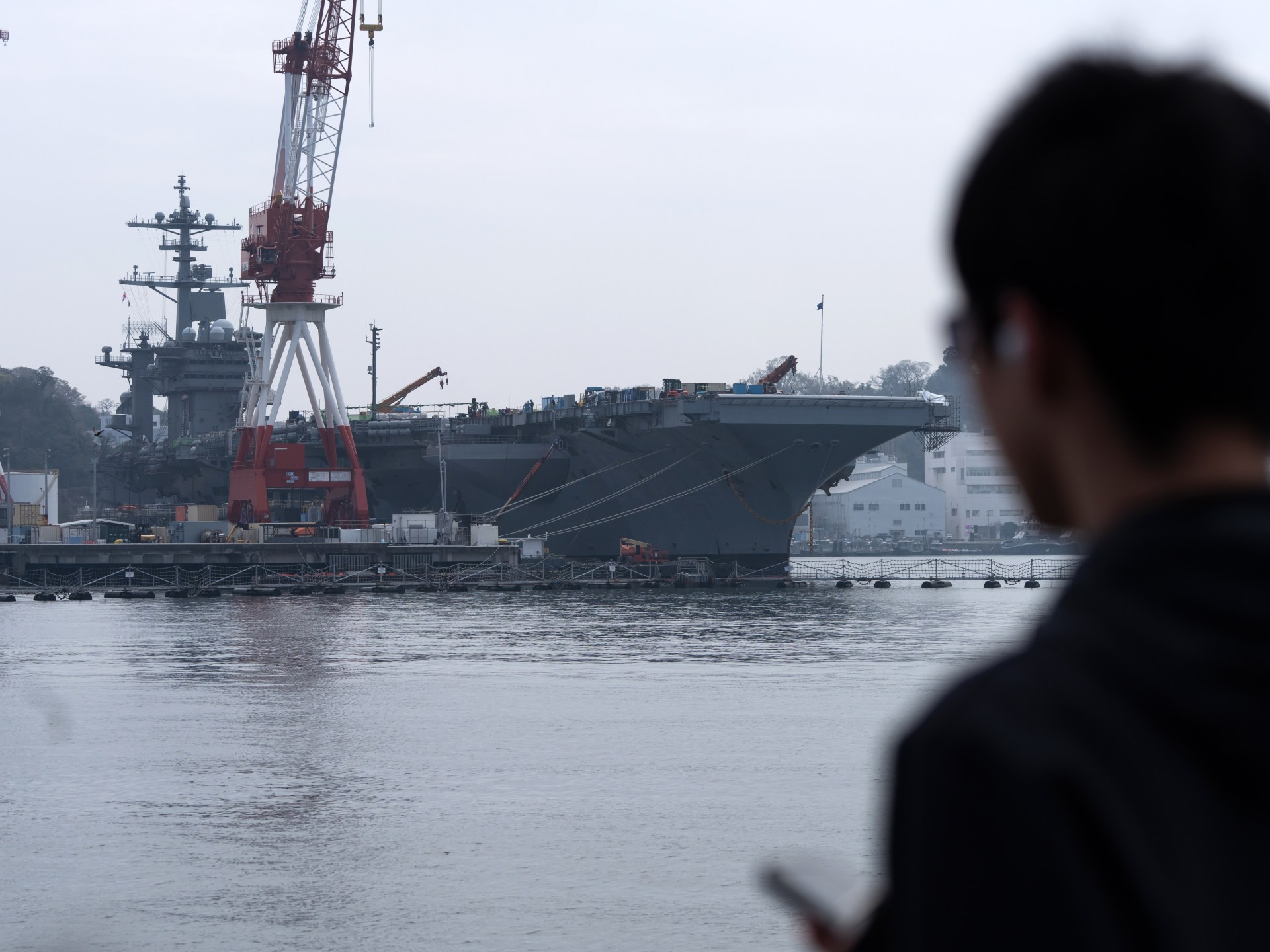
The USS George Washington has started leaving its port in Da Nang, Vietnam, beginning a voyage that is expected to take it to the Middle East.
The vessel is anticipated to take over from the USS Abraham Lincoln, which has been operating in the war the United States and Israel are fighting against Iran.
The departure comes amid growing unease about conditions aboard the USS Lincoln. That carrier has been at sea without a port stop for more than 266 days, a record duration for the Navy, and carries roughly 5,000 sailors and Marines.
Reports of sailors attempting to jump overboard, along with accounts of scarce hygiene supplies, poor food, plumbing failures and waste problems, have circulated in US media. Several US senators have asked for more information about the conditions on board and why the deployment has broken records.
President Donald Trump and acting Secretary of the Navy Hung Cao have both signaled that the ship would be rotated. The Pentagon, however, has not confirmed that the USS George Washington will replace the USS Abraham Lincoln. The Defense Department historically declines to discuss the movements of key military assets for security reasons.
The USS Abraham Lincoln left San Diego, California, last November. It was initially sent to support military operations in Venezuela, then moved to the Middle East. Its deployment had been scheduled to end in May, but after Washington and Israel began the war against Iran in February, the mission was extended indefinitely.
That war has shown no sign of ending, although fighting has been relatively subdued in recent days. Negotiations have stalled over issues including control of the Strait of Hormuz, a strategic waterway for global trade.
Speaking to reporters on Friday, Trump minimized concerns about the ship, saying the length of the carrier’s deployment was “not nearly enough.” A day earlier, Pentagon chief Pete Hegseth said conditions on board had been “completely misrepresented.”
In a separate statement on Friday, Cao insisted the problems on the ship were not dire. He acknowledged that “a small number of mental health cases were treated with no loss of life,” and said meal plans were adjusted “when fresh resupply was unavailable,” but not a single meal had been missed. “There is no question our young men and women have been pushed to their limits, but they have never broken,” Cao added.
Some analysts say Iranian attacks have strained US military resources across the region, particularly a US Navy base in Bahrain, making normal resupply and maintenance for carriers like the Lincoln harder.
Analysts also note that the USS George Washington’s departure from the Pacific leaves no American carrier in the region, where the United States has long served as a counterweight to Chinese power. It was unclear if or when another carrier would be sent to the region.
Bryan Clark, a former Navy submariner and defense analyst at the Hudson Institute, told The Associated Press that Beijing may try to project strength while the carrier is absent to unnerve US allies in the region.
“They’re using this as part of the narrative to demonstrate to the Philippines, to Japan, to Indonesia and others that the US is not the big dog in the western Pacific any more,” Clark said. “They would just prefer that countries in the region decide that China is the bigger power and the US is not able to guarantee their security any more.”
Clark added that he did not think the change alone would embolden China to launch an attack on Taiwan, the island that governs itself and that Beijing claims as its own.
The shift also comes as the US reportedly faces depleted offensive and defensive weapon supplies because of the war with Iran. Those shortages have raised concerns about Washington’s ability to deter military aggression. Critics note that China, unlike Iran, possesses advanced military technology and a large air force that could pose a challenge to the US military.
Like the USS Abraham Lincoln, the USS George Washington is a Nimitz-class nuclear-powered carrier. It can carry more than 6,000 personnel and about 90 aircraft.
The USS George Washington’s departure from Vietnam leaves the Pentagon with no announced replacement carrier in the Pacific, and US officials have not said when another warship might be dispatched to the region.